

Selling furniture is inherently complex. You are managing massive product catalogs, endless custom variants, white-glove delivery expectations, and a buying cycle that can take weeks. Because of these unique operational hurdles, evaluating Shopify for furniture stores requires looking far beyond basic ecommerce features. You need a platform capable of unifying your showroom floor, your warehouse, and your digital storefront into one seamless customer experience.
For modern furniture retailers, the challenge is building a digital journey that gives shoppers the confidence to spend thousands of dollars online, while maintaining strict inventory accuracy on the backend.
This comprehensive guide explores how Shopify addresses the unique needs of furniture retail. We will break down essential features, evaluate point-of-sale (POS) capabilities, highlight successful brand examples, and provide a roadmap for building a high-converting furniture store.
Key Takeaways
- Shopify works for furniture stores because it unifies showroom, warehouse, and online inventory in real time, handles complex variants (fabric × leg style × dimensions), and supports BNPL financing for high-ticket items.
- Top furniture brands on Shopify: Arhaus, Lulu and Georgia, Transformer Table, plus Burrow, Industry West, Albany Park, Article, and Castlery.
- Three core operational challenges Shopify solves: bulky-inventory tracking across showrooms and warehouses; high-variant custom configurations; freight + white-glove delivery scheduling.
- Pricing: Shopify plans start at $39/month, scaling to $399/month (Advanced) or $2,500+/month (Plus). Shopify POS Pro adds $89/month per location.
- 6-step launch: define catalog structure → configure shipping → deploy POS → integrate core apps → set up taxes → test customer journey.
- Building a high-converting store: see our practical guide to building a high-converting home decor Shopify store, or compare themes in our best Shopify theme for home decor roundup.
- The full playbook: for the operator-level walkthrough across niche, theme, PDPs, conversion, freight, B2B, and marketing, see our Selling Home Decor & Furniture on Shopify: An Operator’s Playbook.
Why Shopify Works for Furniture Stores
Historically, furniture retailers relied on clunky, legacy enterprise resource planning (ERP) systems patched together with basic website builders. As a result, inventory was rarely synced, and the online shopping experience felt disconnected from the showroom floor.
Shopify solves this by offering a unified commerce architecture. It acts as the central nervous system for your business, connecting in-store, online, and warehouse operations in real time.
Quick Summary: Is Shopify Right for Furniture?
Pros: Seamless omnichannel inventory sync, robust app ecosystem for white-glove delivery and 3D visualization, built-in financing options (BNPL), and highly scalable cloud infrastructure.
Cons: Complex manufacturing workflows (like raw material tracking) and advanced custom order routing often require third-party apps or custom development.
Ultimately, Shopify excels because it scales effortlessly. Whether you run a single boutique, a growing direct-to-consumer (DTC) brand, or a multi-location enterprise, implementing a robust omnichannel retail strategy on Shopify allows you to meet customers wherever they prefer to shop.
Key Challenges Furniture Retailers Need a Platform to Solve
Furniture retail comes with logistical hurdles that generic ecommerce platforms simply cannot handle. To succeed, your technology stack must address these three core challenges.
Managing bulky inventory across showrooms, warehouses, and online
Unlike apparel or electronics, furniture takes up massive amounts of physical space. Retailers typically operate across fundamentally different inventory environments. Showrooms display floor models, warehouses hold sellable stock, and other pieces might be in transit.
Your platform must distinguish between a display-only sofa on the showroom floor and identical, sellable units in the warehouse. Without this distinction, associates might accidentally sell a floor model or promise delivery on an item that isn’t actually available. Multi-location inventory tracking also ensures that when a customer buys a dining set online, stock is instantly deducted from the correct warehouse, preventing costly backorders.
Handling variants, custom configurations, and made-to-order products
A single sectional sofa can easily generate hundreds of product variants when you factor in fabric choices, leg finishes, arm styles, and chaise orientations.
Treating these variations as simple dropdown menus is a recipe for fulfillment disaster. Your platform needs to track specific custom configurations from the moment the order is placed through manufacturing and final delivery. For made-to-order furniture, upholstery, and special-order workflows, the system must support extended lead times and pass configuration notes directly to your manufacturing partners without manual data entry.
Coordinating delivery, freight, and white-glove fulfillment
Shipping a coffee mug is easy. Shipping a 300-pound solid oak dining table requires a highly orchestrated logistics workflow.
Furniture delivery expectations are incredibly high. Customers want specific delivery windows. Many also require white-glove logistics: the delivery team brings the item inside, assembles it, and removes packaging. Standard shipping label integrations fall short here. You need a platform that integrates with route optimization, calculates complex freight rates at checkout, and handles local delivery scheduling seamlessly.
Shopify POS for Furniture Showrooms and In-Store Selling
The modern furniture shopper rarely buys a high-ticket item without doing extensive research. Often, they browse online, visit a physical showroom to feel the fabric, and then complete the purchase later on their phone. This is where Shopify POS bridges the gap.
Syncing online, in-store, and warehouse inventory in real time
When a customer purchases a bed frame in your physical store, your online inventory must update instantly. Shopify POS shares a single backend with your digital storefront, meaning inventory is always accurate across all locations.
This native integration allows you to offer an “endless aisle” experience. If a customer loves a chair in your showroom but wants it in a color you do not have on the floor, your sales associate can easily process the transaction through the POS and have the item shipped directly from your warehouse to the customer’s home.
Tracking floor models, special orders, and customer profiles
Furniture sales are relationship-driven. Shopify POS allows associates to build detailed customer profiles, tracking past purchases, room dimensions, and design preferences. This facilitates high-level clienteling and assisted selling.
Crucially, the system helps you manage complex order states. You can track floor models, process layaways, and handle special-order handling with ease. If a customer needs time to consult their partner before buying a $4,000 sofa, the associate can create a “saved cart” and email it to the customer, allowing them to complete the checkout securely from home.
What hardware furniture retailers need for Shopify POS
To equip your showroom properly, you do not need clunky, outdated cash registers. Shopify POS hardware is sleek, modern, and mobile.
iPads and iPhones: Associates can walk the floor with a tablet, checking inventory and processing payments right next to the furniture piece.
Card Readers: Tap-to-pay and chip readers allow for secure, rapid checkout.
Scanners and Printers: Rugged Bluetooth barcode scanners are essential for warehouse staff, while sleek receipt printers sit neatly at the consultation desk.
Cash Drawers: For locations that still process cash deposits, secure cash drawers integrate directly with the POS terminal.
Top Shopify Features That Matter Most for Furniture Retail
Shopify is packed with out-of-the-box functionality that directly benefits high-ticket retail operations.
Flexible payments, financing, deposits, and installments
Cart abandonment is notoriously high in the furniture sector due to high price points. Offering flexible payments is no longer optional; it is a necessity.
Shopify integrates natively with Shop Pay Installments and other Buy Now, Pay Later (BNPL) providers. This allows customers to break a $2,000 purchase into manageable monthly payments, dramatically increasing conversion rates and average order value. Shopify also supports split payments and initial deposits, which are vital for securing custom or made-to-order upholstery jobs before manufacturing begins.
Omnichannel fulfillment including pickup, ship-from-store, and endless aisle
Customers expect total control over how they receive their items. Shopify enables Buy Online, Pick Up In-Store (BOPIS), allowing local customers to secure an item online and collect it from your warehouse or showroom.
Additionally, ship-from-store workflows allow you to use your retail showrooms as micro-fulfillment centers. If your main warehouse is out of a specific lamp, but your downtown showroom has three in the stockroom, the order can be routed and shipped directly from the retail location.
Reporting, forecasting, staff permissions, and commission tracking
Data drives profitable retail. Shopify’s centralized reporting gives you real-time business insights into which collections are moving, which fabrics are underperforming, and when you need to reorder seasonal stock.
For store operations, Shopify offers robust staff management tools. You can set granular permissions, ensuring seasonal staff only see what they need to. Most importantly for furniture showrooms, you can track sales by associate, making commission tracking and performance forecasting highly accurate.
How to Build a High-Converting Shopify Furniture Store
Creating a beautiful website is only half the battle. Your store must be meticulously optimized to overcome the inherent friction of buying furniture online.
Choose the right niche, brand, theme, and navigation structure
Start by selecting a premium Shopify theme built for large catalogs and high-resolution imagery. Your navigation structure must be intuitive. Use mega-menus with on-site search and advanced filtering. Let customers browse by room, style, material, size, and color. Since July 2026 that room-and-style browsing can run on native sub collections, with a parent like Living assembling itself from child collections instead of leaning on menu structure alone. Unified brand presentation across channels builds the trust required for high-ticket conversions. For a side-by-side breakdown of theme options, see our best Shopify theme for home decor guide.
Create product pages that answer every buying question
A furniture product page must act as a digital salesperson. According to a Salsify report, missing product details are a primary driver of cart abandonment.
Your product pages must include exact dimensions (with visual diagrams), detailed material and finish descriptions, assembly requirements, shipping timelines, and care details. Do not leave the customer guessing whether a sofa will fit through their front door. For a deeper PDP-level breakdown, see our building a high-converting home decor Shopify store guide.
Use lifestyle imagery, video, AR, and 3D to increase buyer confidence
Online shoppers cannot sit on a sofa or feel the grain of a wooden table. High-quality visuals are your best tool for bridging this sensory gap.
Use a mix of professional studio shots, lifestyle imagery, macro close-ups of fabrics, and video demonstrations. Crucially, adopt augmented reality (AR) and 3D models. According to a 3D Cloud study, shoppers heavily favor sites that allow them to virtually preview how a piece will look in their own living room. Shopify supports native 3D model uploads, allowing customers to project furniture into their space using their smartphone camera.
Optimize mobile experience, speed, SEO, reviews, and trust signals
More than half of all e-commerce traffic comes from mobile devices. Your site must load instantly, even with heavy image galleries. Compress your images and defer the loading of 3D models until the user interacts with them.
Additionally, prioritize SEO and trust signals. Display user-generated content, authentic customer reviews with photos, and clear return policies prominently. If a customer is anxious about a $3,000 purchase, seeing a photo of the item in another customer’s real home can be the final push they need to convert.
Best Shopify Apps and Integrations for Furniture Stores
While Shopify’s core platform is incredibly powerful, the true strength lies in its app ecosystem. You can build a tech stack perfectly tailored to your operational needs.
Inventory, purchase orders, and vendor management
Tracking lead times and managing purchase orders with multiple vendors is critical. While Shopify offers basic inventory tools, many furniture retailers outgrow them and seek robust Shopify Stocky alternatives like Katana or STORIS. These integrations handle deep vendor management, automated purchase orders, and multi-warehouse routing, ensuring you always know exactly when a container of goods is scheduled to arrive.
Delivery scheduling, white-glove logistics, and customer support
To handle complex fulfillment, apps like Zapiet allow customers to select specific delivery dates and times at checkout. For freight and white-glove logistics, specialized routing apps help you generate load sheets and optimize local delivery routes.
Customer support is equally vital. Integrating a helpdesk app like Gorgias allows your support team to see a customer’s entire Shopify order history directly next to their support ticket, making it easy to resolve delivery disputes or warranty claims quickly.
Manufacturing, bundling, accounting, marketing, and B2B tools
If you manufacture your furniture, you will need an app to manage your bill of materials and raw material inventory.
Bundling apps also enable kitting and assembly workflows. For instance, if you sell a dining set, the app will automatically deduct one table and four chairs from your inventory. Finally, leverage Shopify’s native B2B functionality to offer wholesale pricing and trade accounts to interior designers and commercial buyers, expanding your revenue streams.
Examples of Furniture and Home Brands Using Shopify
Many of the most successful and innovative furniture brands in the world run on Shopify. Studying their sites can provide excellent inspiration for your build. For 13 more home decor and furniture examples, see our 13 best home decor Shopify stores roundup.
1. Arhaus

Arhaus: This premium retailer migrated to Shopify to support its massive catalog and omnichannel operations. They utilize stunning lifestyle imagery, an intuitive 3D room planner, and seamless filtering to guide users through thousands of high-end SKUs.
2. Lulu and Georgia
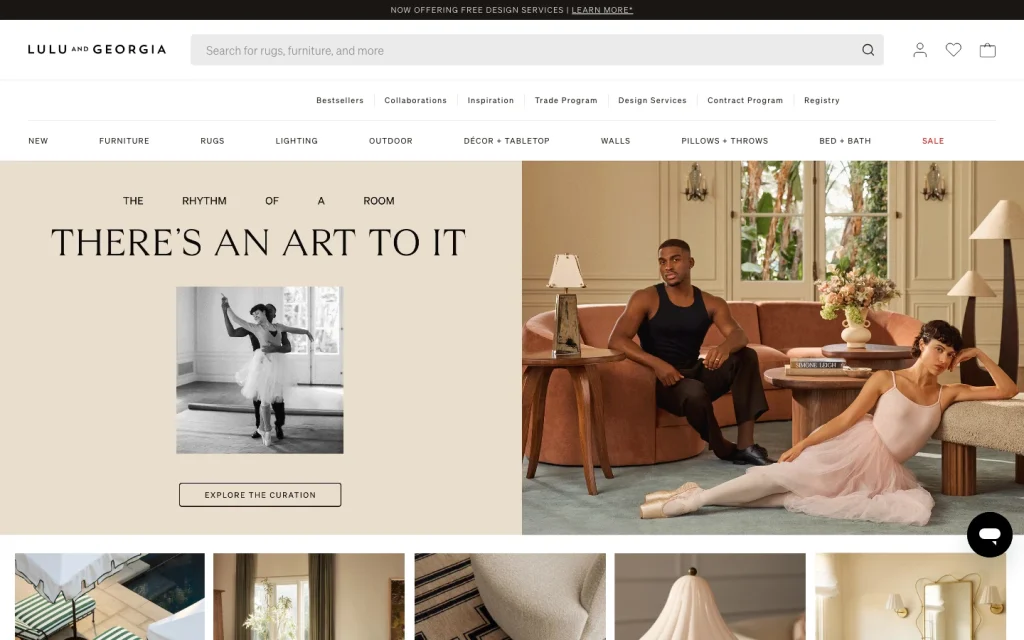
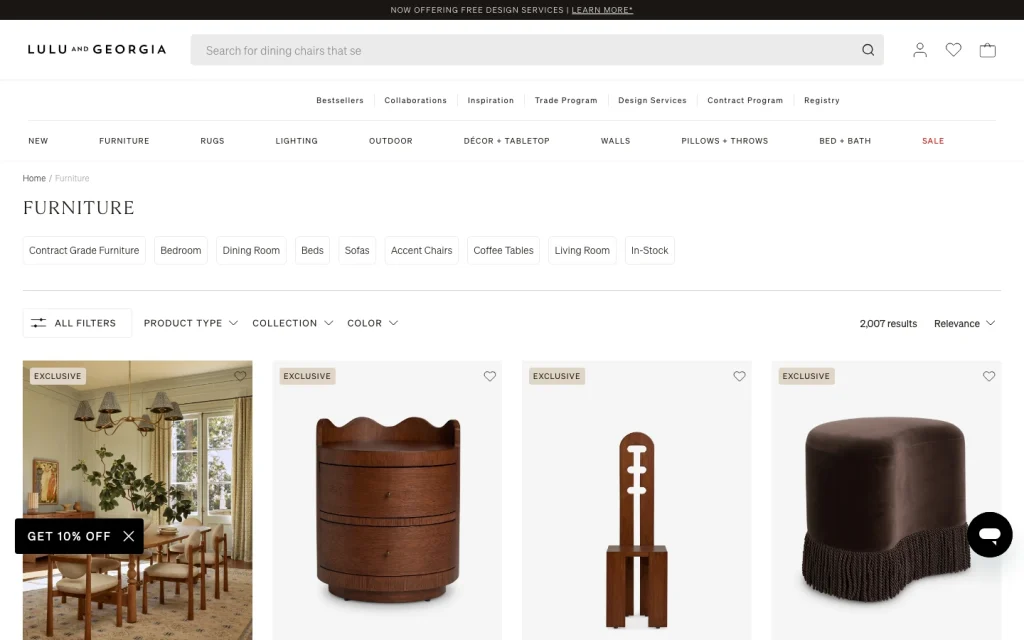
Lulu and Georgia: Known for trendy, chic home decor, Lulu and Georgia leverages Shopify to handle massive traffic spikes. Their site excels at visual merchandising, offering a “Shop the Room” feature that drives incredible cross-selling opportunities.
3. Transformer Table
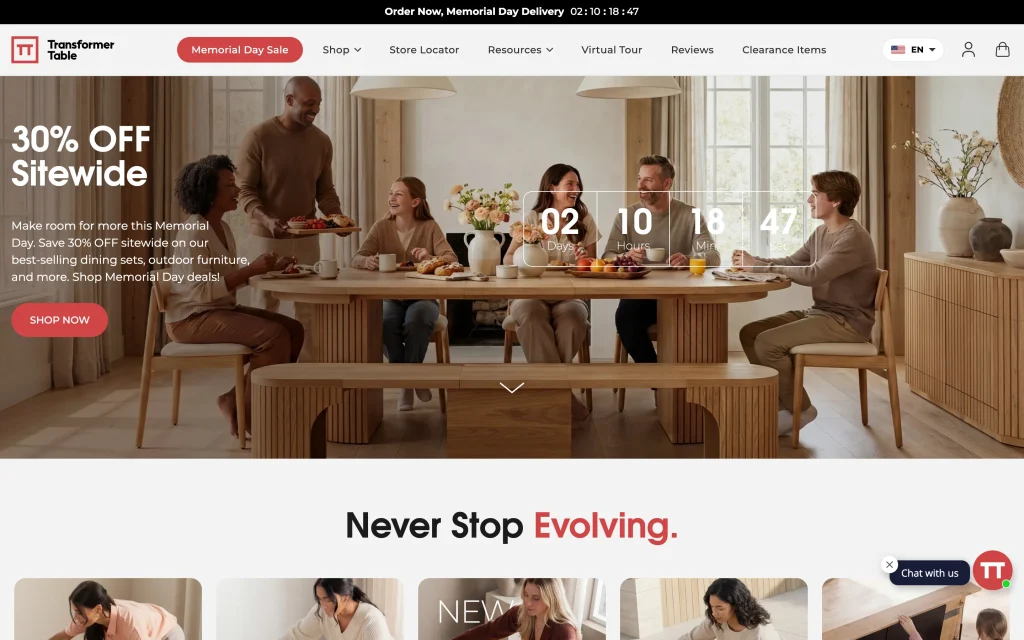
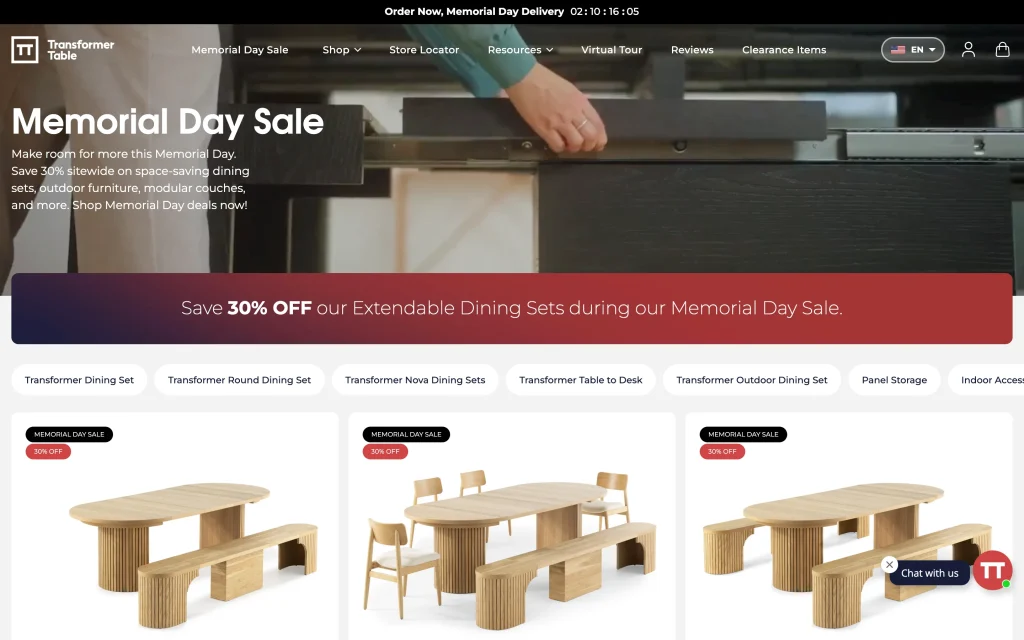
Transformer Table: This innovative modular furniture brand uses highly engaging video content and GIFs directly on their product pages to demonstrate how their tables expand and contract, perfectly answering the customer’s primary buying questions.
All 3 Brands at a Glance
| # | Brand | Catalog scale | Shopify edition | Standout operational pattern |
|---|---|---|---|---|
| 1 | Arhaus | Thousands of high-end SKUs | Shopify Plus + omnichannel | Native 3D room planner across catalog |
| 2 | Lulu and Georgia | Mid-large catalog (decor + furniture) | Shopify Plus | “Shop the Room” cross-sell mechanic |
| 3 | Transformer Table | Focused single-product line | Shopify (likely Advanced) | Video + GIF-led PDPs explaining a complex product |
How to Set Up Shopify for a Furniture Store
Launching a robust furniture store requires careful planning. Follow this step-by-step checklist to ensure a smooth deployment.
Step-by-step launch checklist for catalog, POS, taxes, shipping, and apps
Step 1: Define Your Catalog Structure
Organize your products logically. Use tags and meta-fields to capture variant data like fabric types, dimensions, and lead times.
Step 2: Configure Shipping and Freight
Set up shipping profiles. Separate standard parcel items (like pillows) from heavy freight items (like sofas) to ensure accurate checkout pricing.
Step 3: Deploy Shopify POS
If you have a physical location, set up your hardware, map your locations, and train staff on how to process endless aisle orders and layaways.
Step 4: Integrate Core Apps
Install necessary apps for delivery scheduling, 3D model viewing, and advanced inventory management.
Step 5: Set Up Taxes and Accounting
Ensure your tax settings account for different state nexus laws, especially if you are shipping large items across the country.
Step 6: Test the Customer Journey
Place test orders on mobile and desktop. Verify that BNPL options work, shipping calculates correctly, and confirmation emails are clear.
Shopify for Furniture Stores: Pros, Cons, and Costs
Before making a platform decision, it is vital to understand the total cost of ownership and where the platform excels versus where it requires augmentation.
Where Shopify shines for boutiques, growing retailers, and multi-location stores
Shopify is unmatched in its ease of use, uptime reliability, and omnichannel capabilities. For boutiques and growing retailers, the standard Shopify plans offer incredible value, providing enterprise-grade checkout speeds without the need for an in-house IT team. For larger, multi-location chains, Shopify Plus offers the API limits, B2B functionality, and automation necessary to scale globally. The predictable pricing plans mean you can forecast your technology costs accurately as you grow.
Where you may need apps, custom workflows, or a different system
Shopify is not a dedicated warehouse management system (WMS) or a manufacturing ERP out of the box. If your business relies heavily on tracking raw materials (wood, fabric rolls, foam) or requires complex serial/lot tracking for warranty and recall support, you will need to integrate a third-party app. Additionally, highly complex custom furniture builders—where a customer designs a piece from scratch altering dimensions by the inch—often require custom app development to function smoothly.
Frequently Asked Questions About Shopify for Furniture Stores
What furniture stores use Shopify?
Top furniture brands like Arhaus, Lulu and Georgia, Albany Park, Industry West, and Transformer Table all use Shopify. The platform scales easily to accommodate both boutique design shops and massive, multi-location enterprise furniture chains handling thousands of SKUs and custom variants.
Do people sell furniture on Shopify?
Yes, thousands of merchants sell furniture on Shopify. The platform is highly optimized for the home goods sector, offering tools to manage large product catalogs, 3D/AR visualization, complex shipping profiles, and omnichannel fulfillment connecting online sales with physical showrooms.
What is the downside to Shopify?
The main downside to Shopify for furniture stores is that complex manufacturing workflows, raw material tracking, and advanced white-glove delivery scheduling are not built into the core platform. Retailers usually need to rely on third-party apps or custom development to handle these specific logistical needs.
Do I need an LLC to run a Shopify store?
You do not strictly need an LLC to start a Shopify store; you can operate as a sole proprietor. However, because furniture involves high-ticket items, heavy freight, and potential liability (e.g., tip-over risks), forming an LLC is highly recommended to protect your personal assets.
Is Shopify discontinuing POS?
No, Shopify is not discontinuing its POS system. In fact, Shopify is heavily investing in unified commerce, continually releasing new hardware, advanced inventory routing features, and enhanced omnichannel capabilities designed specifically to bridge the gap between digital storefronts and physical retail locations.
Does Shopify work well for furniture stores?
Yes, Shopify works exceptionally well for furniture stores. It handles high-resolution lifestyle imagery, supports augmented reality (AR) for room visualization, offers flexible financing options like Shop Pay Installments, and manages multi-location inventory across warehouses and showrooms effectively.
What are the benefits of Shopify for furniture retailers?
Key benefits include seamless omnichannel inventory syncing, a robust app ecosystem for delivery scheduling, built-in BNPL financing to boost conversions on high-ticket items, and an intuitive POS system that empowers sales associates to offer personalized clienteling and endless aisle shopping in-store.
Can Shopify handle custom furniture orders and product variants?
Yes, Shopify can handle custom orders and variants. While the native platform supports multiple options (size, color, material), merchants selling highly customized, made-to-order furniture can use product configurator apps to capture specific design notes, lead times, and complex pricing structures.
Can Shopify manage showroom and online inventory together?
Absolutely. Shopify acts as a centralized database for your business. When an item is sold in your physical showroom via Shopify POS, the stock level is instantly updated on your online store, preventing overselling and keeping your inventory data perfectly accurate across all locations.
How do furniture stores handle delivery scheduling on Shopify?
Furniture stores handle delivery scheduling on Shopify by integrating third-party logistics and local delivery apps. These apps allow customers to select specific delivery dates and time windows at checkout, and they help merchants optimize delivery routes and manage white-glove fulfillment teams.
Can customers finance furniture purchases on Shopify?
Yes, customers can easily finance furniture purchases. Shopify integrates seamlessly with Buy Now, Pay Later (BNPL) services like Shop Pay Installments, Affirm, and Klarna. Offering these flexible payment options significantly reduces cart abandonment and increases average order value for high-ticket items.
How much does Shopify cost for a furniture store?
Shopify plans start at $39/month for basic setups, scaling to $399/month for Advanced plans, and starting at $2,500/month for enterprise-level Shopify Plus. Additionally, Shopify POS Pro costs $89/month per physical location. You must also budget for premium themes and third-party apps.
How do I build a Shopify furniture store that converts?
To build a high-converting store, use a clean, visually driven theme. Provide exhaustive product details (dimensions, materials, care instructions). Utilize high-quality lifestyle photography and AR models. Offer transparent shipping costs, easy navigation by room or style, and flexible BNPL financing options.
How do furniture stores manage showroom and warehouse inventory on Shopify?
By using Shopify Locations, merchants can assign inventory to specific physical spaces. The system tracks whether a sofa is a floor model in a showroom or sellable stock in a warehouse. Orders can be routed intelligently, allowing for ship-from-store or Buy Online, Pick Up In-Store (BOPIS) workflows.
Can Shopify support white-glove delivery and scheduling for furniture?
While Shopify does not offer native white-glove routing, it fully supports it through app integrations. Merchants can use specialized logistics apps to capture delivery instructions, schedule installation windows, and generate detailed manifests for their freight and white-glove delivery partners.
Conclusion: Is Shopify the Right Fit for Your Furniture Business?
The furniture industry is undergoing a massive digital transformation. Consumers expect the tactile, consultative experience of a physical showroom to be mirrored by a frictionless, informative online shopping journey.
Shopify proves to be an exceptionally strong platform for furniture retailers because it removes the friction between physical and digital sales. By centralizing your inventory, customer data, and payment processing, Shopify allows you to focus on what matters most: curating incredible products and delivering exceptional customer service.
Whether you are a local boutique looking to expand your digital footprint or an established enterprise dealing with complex omnichannel fulfillment, Shopify provides the scalable infrastructure necessary to grow. If you are ready to modernize your retail operations and build a high-converting digital storefront, it may be time to hire a Shopify agency with the technical expertise to tailor the platform perfectly to your furniture brand’s unique needs.