
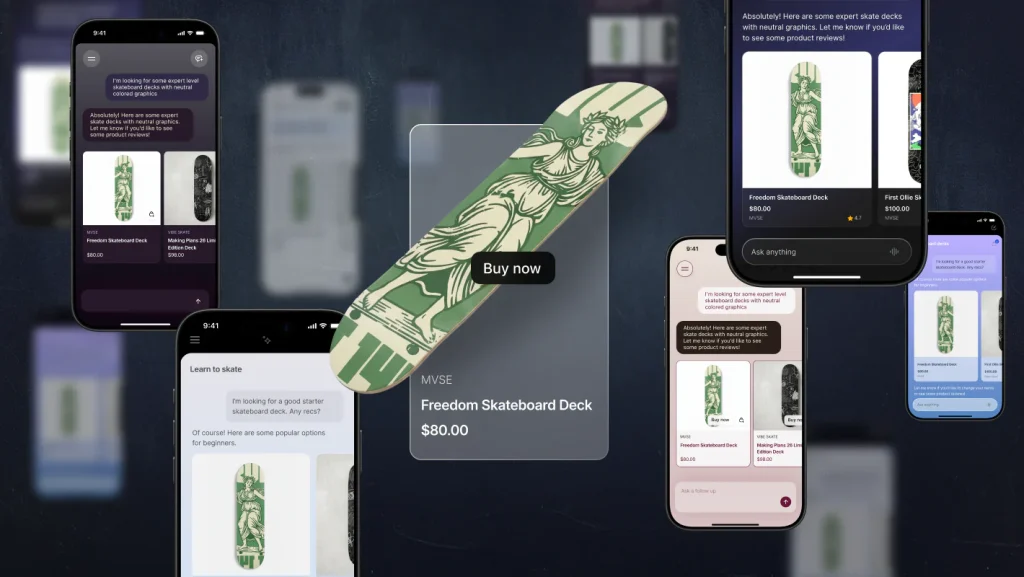
The e-commerce landscape is undergoing a fundamental architectural shift. For the past two decades, digital shopping has relied on a predictable model: a human types a keyword into a search engine, clicks a link, browses a website, and manually completes a checkout. Today, that model is evolving. If you are wondering what Shopify’s Agentic Storefronts mean for your brand, the answer lies in the transition from human-led browsing to AI-assisted buying.
Shoppers are increasingly turning to AI platforms to bypass the traditional search-and-filter process. Instead of scrolling through category pages, they are delegating the heavy lifting to intelligent agents. For forward-thinking merchants, this represents a massive opportunity. However, it also requires a strategic shift in how you structure your product data, manage your brand voice, and approach your overall omnichannel retail strategy.
Here is everything you need to know to prepare your business for the era of agentic commerce.
What are Shopify Agentic Storefronts (in plain English)?
Shopify Agentic Storefronts are AI-powered sales channels that allow intelligent agents to actively discover products, compare options, and complete purchases on behalf of shoppers directly within chat interfaces like ChatGPT. Unlike standard chatbots, these agents execute transactions using your store’s live catalog and checkout infrastructure.
To fully grasp this, you must understand the difference between conversational commerce and agentic commerce. Conversational commerce helps a customer decide (e.g., a chatbot answering sizing questions). Agentic commerce helps a customer buy (e.g., an AI agent finding the right size, applying a discount, and processing the payment).
Here is how agentic storefronts compare to traditional e-commerce models:
| Feature | Traditional Storefront | Conversational Commerce | Agentic Commerce |
|---|---|---|---|
| Who controls discovery? | The human shopper (via search & navigation) | The human shopper (guided by AI suggestions) | The AI agent (matching intent to catalog data) |
| Where checkout happens | On your website | On your website | Directly in-chat (or redirected to your site) |
| What data matters most | Visual merchandising & traditional SEO | FAQs & customer support scripts | Machine-readable structured data & APIs |
| Measurement focus | Pageviews, bounce rate, on-site conversion | Chat engagement, ticket deflection | AI channel attribution, assisted conversions |
How agentic shopping works: from AI conversation to Shopify order
The beauty of Shopify Agentic Storefronts is that they seamlessly bridge the gap between external AI platforms and your internal commerce operations. The process is designed to be frictionless for both the buyer and the merchant.
First, a shopper prompts an AI assistant. For example, they might say, “Find me a sustainable, ethically sourced coffee subscription for under $30, delivered monthly.” The AI agent parses this request into distinct constraints and searches the Shopify Catalog for matching products.
Next, the agent presents a curated shortlist directly within the chat interface. The shopper can ask follow-up questions, compare options, and make a final selection without ever opening a new browser tab. Finally, the agent facilitates the checkout using Shopify’s secure infrastructure, and the completed order drops directly into your Shopify Admin just like any standard web order.
Discovery vs checkout: what happens in-chat vs on your site
Crucially, merchants have choices regarding how this transaction concludes. You can enable full in-chat checkout, allowing the AI to process the payment right there. This drastically reduces friction and capitalizes on high-intent moments.
Alternatively, if you prefer to keep the final transaction on your domain, you can opt to use AI strictly for product discovery. In this scenario, the agent recommends your product but provides a link that redirects the shopper to your website to complete the purchase.
What this means for your brand: control, customer ownership, and the new “AI channel”
A common fear among merchants is that selling through AI means sacrificing control over the customer experience. Fortunately, Shopify has designed this ecosystem to protect your brand equity.
First and foremost, you remain the merchant of record. When a transaction occurs via an agentic storefront, you retain full ownership of the customer relationship. You receive their contact information, shipping details, and order history, allowing you to trigger your standard post-purchase email flows and retention campaigns.
Furthermore, you have granular control over your channel settings. You can toggle specific AI platforms (like ChatGPT or Microsoft Copilot) on or off at will. You can also dictate product-level availability, ensuring that complex items—such as highly personalized custom goods—are only sold directly on your website.
The tech behind it (without the jargon): Shopify Catalog + UCP/ACP
For AI agents to reliably buy products on behalf of humans, they need a standardized way to read and interact with e-commerce data. Without a shared language, an AI would have to learn the unique layout and coding of millions of different websites—an impossible task.
This is where the Universal Commerce Protocol (UCP) and Agentic Commerce Protocol (ACP) come into play. Co-developed by Shopify and other major tech players, UCP acts as a universal translator. It structures your store’s data—pricing, inventory, shipping rules, and return policies—into a format that any AI agent can instantly understand and act upon.
By leveraging the Shopify Catalog, your store automatically translates its data into this machine-readable format. As a merchant, you do not need to learn complex coding or build custom API integrations. You simply need to ensure your backend data is clean and accurate.
How to prepare your store: product data, Knowledge Base, and channel settings
In the agentic era, “data UX” is your new storefront. If your product data is vague or disorganized, AI agents will simply pass over your catalog in favor of a competitor whose data is easier to read. Preparing your store requires a dual focus: optimizing your product attributes and training the AI on your brand guidelines.
Product data checklist (titles, attributes, variants, inventory, metafields)
To win in agentic search, precision is non-negotiable. Vague marketing fluff like “premium quality” means nothing to an AI. Instead, you must use detailed, structured attributes. Investing in professional Shopify SEO services can help ensure your catalog is fully optimized for machine readability.
Knowledge Base checklist (FAQs, policies, brand voice guardrails)
AI agents need to know how to speak on your behalf. Shopify facilitates this through its dedicated Shopify Knowledge Base app. By populating this app, you provide the AI with the exact answers it needs to handle customer objections confidently.
To help you prepare, here is a prioritized 10-step quick-start checklist:
- Audit your product titles: Ensure they are descriptive and include key identifiers (brand, model, color, size).
- Standardize variants: Clean up messy variant groupings so AI can easily differentiate between sizes and colors.
- Enrich metafields: Add structured data for materials, care instructions, and sustainability certifications.
- Sync real-time inventory: Ensure your stock levels are perfectly accurate to prevent AI agents from selling out-of-stock items.
- Install the Knowledge Base App: Download the app from the Shopify App Store to begin training your AI.
- Upload store policies: Clearly define your shipping, return, and exchange rules in plain text.
- Define brand voice guardrails: Instruct the AI on your brand’s tone (e.g., professional, playful, technical).
- Map out FAQs: Add direct answers to your top 10 most common customer support questions.
- Review channel eligibility: Ensure your products are eligible for inclusion in the Shopify Catalog.
- Test and toggle: Select which AI channels you want to activate and monitor the initial interactions.
Costs, eligibility, and limitations to know before you enable it
While the potential of agentic commerce is vast, it is currently in its early stages. Access is rolling out regionally, typically starting with US-based merchants.
There are also strict eligibility requirements. For instance, you must have clear store policies visible on your site, and you cannot force an account login prior to checkout.
Financially, merchants should view AI channels through the lens of Customer Acquisition Cost (CAC). While Shopify does not charge extra for the infrastructure, platforms like ChatGPT may impose a transaction fee (reportedly around 4% after an initial trial period). For many brands, this fee is easily justified by the high conversion rates and zero ad-spend required to acquire these high-intent shoppers.
However, there are limitations to consider:
| Category | Requirements & Limitations |
|---|---|
| Geographic Region | Currently limited to early access (primarily US merchants). |
| Customer Accounts | Cannot require customers to log in before checking out. |
| Complex Logic | Fractional quantities, complex bundles, and highly custom personalization are not fully supported in-chat. |
| Merchandising | Loss of on-site control over post-add-to-cart upsells and cross-sells. |
| Platform Fees | Potential commissions (e.g., 4% on ChatGPT) depending on the AI interface used. |
To mitigate the loss of on-site upselling, merchants must lean heavily into post-purchase email marketing and unboxing experiences to drive lifetime value.
How to measure success: attribution, insights, and early KPIs
One of the most significant advantages of Shopify’s implementation is transparent attribution. Orders placed through AI channels are not lumped into a generic “direct” or “referral” bucket. Instead, they appear in your Shopify Admin clearly tagged with the specific AI platform (e.g., ChatGPT or Microsoft Copilot).
When evaluating this new channel, do not just look at top-line revenue. Monitor your assisted conversions and the specific topics or questions shoppers are asking the AI. This qualitative data is a goldmine for your wider marketing strategy. If you notice a trend in AI inquiries regarding a specific product feature, you can highlight that feature more prominently on your main website. Regularly utilizing Shopify audit services can help you align your on-site experience with these new AI-driven insights.
Set realistic expectations early. Agentic commerce is not going to replace your primary storefront overnight. Treat it as an emerging, high-converting acquisition channel that will compound in value as consumer habits shift.
FAQ: Shopify Agentic Storefronts
What is an agentic storefront on Shopify?
An agentic storefront is an AI-powered sales channel that allows intelligent agents to discover, recommend, and purchase products on behalf of shoppers directly within chat interfaces, using your live Shopify catalog and checkout.
What is Shopify agentic commerce?
It is the shift from passive, human-led website browsing to active, AI-assisted buying. AI agents handle the discovery, comparison, and transaction phases autonomously or semi-autonomously based on the shopper’s prompt.
How do Shopify Agentic Storefronts work with ChatGPT, Perplexity, and Copilot?
Shopify syndicates your structured product data to these platforms via the Universal Commerce Protocol. When a user asks a shopping question, the AI queries your catalog and can process the checkout directly within the chat window.
Is agentic commerce the same as conversational commerce or a chatbot?
No. Conversational commerce uses chatbots to answer questions and guide decisions, but the user still has to manually navigate the site to buy. Agentic commerce empowers the AI to actually execute the transaction on the buyer’s behalf.
Do I lose control of my brand or customer relationship if people buy in AI chat?
No. You remain the merchant of record. All orders flow directly into your Shopify Admin with complete customer data, allowing you to maintain the relationship and trigger post-purchase marketing.
How do I control what AI says about my products and policies?
You control the narrative by using the Shopify Knowledge Base app. By uploading your FAQs, shipping policies, and brand voice guidelines, you train the AI to represent your business accurately.
What is Shopify’s Universal Commerce Protocol (UCP)?
UCP is an open standard co-developed by Shopify that translates your store’s complex backend data (inventory, pricing, shipping) into a universal, machine-readable format that any AI agent can understand.
How do I prepare my Shopify product data for agentic commerce?
You must ensure your data is highly structured. Use clear, descriptive titles, organize variants logically, maintain real-time inventory accuracy, and enrich your metafields with specific product attributes.
Can I opt out of selling via AI or limit which products/channels are included?
Yes. You can toggle specific AI platforms on or off in your Shopify Admin. You can also exclude specific products from AI sales channels while keeping them available on your main website.
Are there fees for orders placed through AI channels (e.g., ChatGPT)?
While Shopify does not charge extra for the integration, the AI platforms themselves may charge a commission. For example, ChatGPT is expected to charge a 4% transaction fee after an initial free trial period.
How do I track and attribute sales coming from AI platforms in Shopify?
Orders processed through agentic storefronts are clearly tagged in your Shopify Admin with the exact AI channel they originated from, giving you full visibility into channel performance.
Conclusion: the next best step for your brand
The transition to AI-assisted shopping is no longer a distant prediction; it is actively happening. Understanding what Shopify’s Agentic Storefronts mean for your brand is the first step toward future-proofing your business. By optimizing your structured data, training AI agents through the Knowledge Base app, and embracing this new acquisition channel, you can capture high-intent buyers exactly where they are already spending their time.
Do not wait for your competitors to define the AI shopping experience in your niche. If you are ready to make your catalog machine-readable and maximize your visibility across AI platforms, it is time to take action. Reach out to hire shopify agency experts who can seamlessly integrate your brand into the future of commerce.