
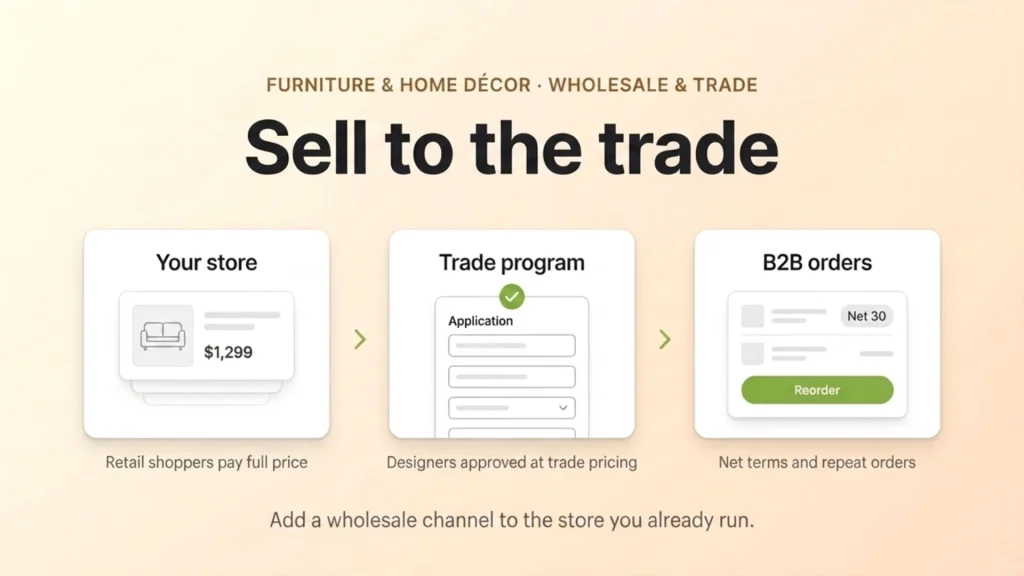
An interior designer trade program gives designers discounted access to your catalog, usually 20 to 30 percent off retail, in exchange for repeat project business. A wholesale channel does the same for retail stores buying in bulk. For years, offering trade pricing or wholesale accounts on Shopify required Shopify Plus or a stack of workaround apps.
That changed on April 2, 2026, when Shopify rolled its native B2B suite out to every plan. Meanwhile, US B2B ecommerce grew 13% to $2.93 trillion in 2025 (Digital Commerce 360). The designers and buyers behind that growth expect to order the way they shop at home: self-serve, online, with their pricing already applied. This guide walks through adding both channels to the furniture or home décor store you already run.
Key Takeaways
- B2B is on every Shopify plan now: since April 2, 2026, company profiles, trade-priced catalogs, quantity rules, vaulted cards, and net payment terms are included on Basic, Grow, and Advanced. Core plans get up to 3 active catalogs; Plus removes the cap.
- Trade and wholesale are different programs: designers buy project by project at 20 to 30 percent off retail (Burrow, Crate & Barrel, and Pottery Barn publish 20%; Arhaus a minimum of 30%); retailers buy bulk at deeper wholesale pricing. Price and vet them separately.
- The payoff Shopify reports: merchants adopting Shopify B2B see up to a 33% increase in self-serve orders within six months and up to 4.1x higher reorder frequency compared to DTC orders.
- Furniture math first: freight, white-glove delivery, lead times, and swatch programs must be priced into trade tiers before launch. A discount set from competitor percentages instead of your landed margin fails quietly.
- Faire extends your reach: Shopify’s recommended wholesale marketplace takes a 15% commission on marketplace orders and 0% on Faire Direct customers you bring yourself, with inventory synced to your store.
Wholesale, Trade Program, or Marketplace: Which B2B Channel Fits?
The three B2B channels serve different buyers at different price points, and the right first move depends on your margins and capacity. Wholesale sells bulk quantities to retail stores, traditionally at keystone pricing (the retailer doubles your price). A trade program serves interior designers buying for one client project at a time, at a shallower discount. A marketplace like Faire brings retail buyers to you and takes a commission instead of requiring a sales operation.
| Channel | Buyer | Typical pricing | Order pattern | Best first move for |
|---|---|---|---|---|
| Trade program | Interior designers, decorators, architects | 20 to 30% off retail | Recurring, project-based, mixed carts | DTC brands with premium price points and designer-friendly product |
| Wholesale | Retail stores, boutiques | Keystone or deeper off retail | Bulk purchase orders, seasonal | Brands with production capacity and products that ship profitably by the case |
| Marketplace (Faire) | Independent retailers | Your wholesale price, 15% commission | Discovery-driven, smaller first orders | Brands without a wholesale list or sales team |
For most furniture and home décor brands, the trade program comes first. Interior design services are a $154 billion market worldwide in 2026 (Mordor Intelligence). Those designers buy at trade pricing as a matter of course. If your store already runs on the fundamentals from our home décor & furniture operator’s playbook (a tight niche, dimension-complete product pages, honest freight), your catalog speaks their language. Wholesale and Faire can layer on once trade pricing proves out.
What Changed in April 2026: Native B2B on Every Shopify Plan
Shopify moved its core B2B feature set from Plus-only to all plans on April 2, 2026. Company profiles, custom catalogs with tailored pricing, volume discounts and quantity rules, vaulted credit cards, and payment terms now ship with Basic, Grow, and Advanced. Shopify’s stated results from merchants already using the suite: up to a 33% increase in self-serve orders within six months (Shopify, April 2026). Reorder frequency runs up to 4.1x higher than DTC orders.
| Feature | Basic / Grow / Advanced | Shopify Plus |
|---|---|---|
| B2B catalogs | Up to 3 active | Unlimited |
| Company profiles & buyer locations | Included | Included |
| Quantity rules & price breaks | Included | Included |
| Net payment terms, vaulted cards, ACH | Included | Included |
| Draft orders, invoicing, PO numbers | Included | Included |
| Trade theme & quick order list | Included | Included |
| Deposits & partial payments | Not included | Included |
| Direct company catalogs | Not included | Included |
Source: Shopify B2B features by plan. The practical read for a furniture brand: three catalogs cover a standard setup (a designer trade tier, a volume trade tier, and a wholesale tier) without a Plus upgrade.
Read more → For whether Plus is worth it at your revenue level after this change, see when to upgrade to Shopify Plus.
How to Launch an Interior Designer Trade Program & Wholesale Channel
The sequence below assumes a live DTC store on any current Shopify plan. Budget a working week for setup and another for the application page and outreach. Nothing here requires a replatform or a second store.
Step 1: Choose a blended or dedicated store structure
By the end of this step, you will know whether B2B lives inside your current store or in a separate one. A blended store serves retail and B2B from one catalog: designers log into a company account and see their pricing; retail shoppers see nothing different. A dedicated B2B store splits wholesale onto its own storefront.
For most furniture and décor brands under eight figures, blended is the right call: one inventory pool, one theme, no divided SEO equity. Dedicated setups earn their keep when wholesale carries different branding, catalogs, or international logistics. Verify the choice by logging in as a test company and confirming trade pricing renders on a product page.
Step 2: Set your trade discount tiers before touching the admin
By the end of this step, you will have discount percentages you can defend against your landed costs. The published benchmarks: Burrow offers trade partners 20% off retail, and Arhaus relaunched its trade program in April 2026 with a minimum 30% discount on regularly priced items. Crate & Barrel and Pottery Barn’s design trade program both publish 20%, Pottery Barn’s as a starting rate. At the entry end, Article runs a tiered Pro Pricing program at 5 to 15 percent off its catalog. Across the industry, retail-brand trade programs cluster between 10 and 20 percent, while trade-only manufacturers such as Four Hands and Visual Comfort run 30 to 50 percent off list (Procurist, 2026).
Price from your margin after freight, not from competitor percentages. A sofa that loses 8 percent of its price to freight and damage claims cannot carry the same trade discount as a throw pillow that ships parcel. Two tiers work for most brands: a standard trade tier around 20 percent, and a volume tier that unlocks deeper pricing at quantity thresholds.
Step 3: Create company profiles and catalogs
Once this step is done, approved buyers see their pricing automatically. In Shopify admin, go to Customers → Companies and create a company for each approved designer or retailer. Then build catalogs that apply your tiers: a percentage adjustment across the catalog, or fixed prices per product. Core plans allow up to three active catalogs, an allocation that maps cleanly to the two trade tiers plus one wholesale tier from Step 2.
Add quantity rules where they matter: minimum units on décor that ships by the case, price breaks at volume on larger furniture pieces. Verification: a logged-in test company sees adjusted prices and quantity minimums on the storefront.
Step 4: Configure payment terms and self-serve checkout
The goal here: a designer places and pays for an order without emailing you. Turn on net payment terms (Net 30, meaning payment is due 30 days after the invoice, is the default expectation in the trade), vaulted credit cards kept on file for repeat orders, and ACH bank transfers for larger invoices. Draft orders and PO number support handle the retailers who still work from purchase orders.
The expectation is real. 73% of B2B buyers are now willing to spend $50,000 or more per order through self-serve digital channels, up from 59% two years earlier (McKinsey B2B Pulse 2024, via Digital Commerce 360). A trade program that ends in “email us for an invoice” loses to one that checks out.
Step 5: Build the application page and vet every member

This step produces a public trade page that qualifies buyers for you. The page needs three things: who qualifies, what they get, and a short application. Ask for business name, EIN or resale certificate, a portfolio or website, and optionally a design association membership (ASID, NKBA, IDS). Approve applicants into a company profile with the matching catalog, and route rejections politely.
Publish the discount range and perks on the page itself: designers comparison-shop trade programs the way consumers comparison-shop sofas, and a vague “contact us for trade pricing” page converts worse than a concrete one.
Step 6: Price in furniture-specific operations
This is the step that decides whether your program survives its first bulk order. Four line items determine whether trade margins hold for furniture and décor:
- Freight: Bulk orders ship LTL (less-than-truckload freight), not parcel, and white-glove delivery has its own tiers.
- Lead times: Made-to-order pieces need stated production windows on the product page.
- Swatches: Designers expect a memo or swatch program (returnable samples) before specifying fabric.
- Order minimums: A floor protects you from trade-discounted single-item orders that behave like retail.
Put each one in writing on the trade page before launch.
Read more → For freight classes, white-glove tiers, and large-catalog operations in depth, see the Shopify for furniture stores guide.
Step 7: List on Faire to reach retail buyers
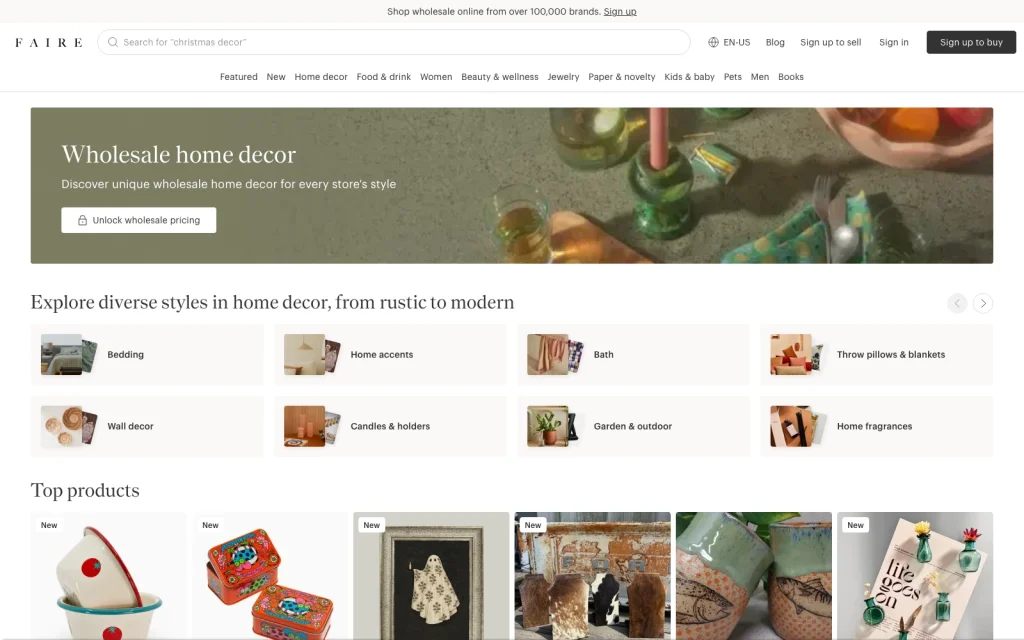
The last step puts you in front of independent retailers without cold outreach. Faire, Shopify’s recommended wholesale marketplace since September 2023, hosts over 100,000 brands. Its home décor catalog alone spans more than 27,000 brands and 5 million products. The integration syncs your Shopify catalog and inventory, so wholesale orders do not oversell your DTC stock.
The fee structure rewards bringing your own list. Marketplace orders carry a 15% commission plus a one-time $10 fee on a new customer’s first order. Faire Direct orders from customers you invite yourself carry 0% commission (Faire Help Center). Use the marketplace for discovery and point your existing wholesale contacts at Faire Direct.
Across the home décor and furniture builds our team has shipped, the B2B unlock usually arrives in year two, after the DTC store proves the catalog. Lewis & Sheron Textiles is a four-generation Atlanta fabric house. When we built their interior designer partner program, we ran the pattern in this guide: a real trade offer, a qualification form, and a follow-up sequence. It generated 30+ commercial leads alongside a 16% traffic lift. The program worked because the offer was concrete and the vetting was real.
How Do You Find Designers for Your Trade Program?
Designers find suppliers through peers, directories, and search, so recruitment is a distribution job, not an ads budget. The application page from Step 5 is the engine: designers search phrases like “furniture trade program” and your brand name plus “trade” when they evaluate suppliers. A public page with a concrete discount ranks for those queries; a gated PDF cannot.
Three channels do most of the early work:
- Local design firms: Send a short outreach note to studios in your metro with the trade offer and two or three products that fit their portfolio. Ten personal notes beat a thousand cold emails here.
- Association chapters: ASID and NKBA chapters publish member directories and host trade events where vendors are expected, not merely tolerated.
- Your own order history: Repeat buyers with studio email domains or commercial shipping addresses are usually designers already paying retail. Invite them first; they convert fastest.
What Mistakes Sink Furniture Trade Programs?
The most common failure is launching trade pricing as a discount code instead of a B2B structure. Codes leak to coupon sites, carry no company record or net terms, and give you no reorder view. The rest of the frequent failures:
1. One flat discount for every buyer. A designer buying two chairs and a boutique buying forty are different businesses. Averaging them into one percentage overpays the small buyer and underprices the large one. Tier by buyer type and volume.
2. Quoting trade prices before freight. Furniture-specific and fatal: an LTL shipment with white-glove delivery can consume the entire margin on a trade-discounted order. Land your costs first, then set the discount.
3. Approving everyone. An unvetted trade program is a permanent sale. Verify resale certificates and portfolios, and re-verify yearly. Designers respect programs that are hard to get into; it signals the discount is real.
4. Ignoring the reorder experience. Shopify’s own data puts B2B reorder frequency at up to 4.1x DTC. That compounding only happens if repeat ordering is effortless: vaulted cards, quick order lists, and saved company addresses are the retention mechanics, not the application page.
Frequently Asked Questions
What discount should a furniture trade program offer?
Retail-facing trade programs in home furnishings typically offer 20 to 30 percent off retail: Burrow, Crate & Barrel, and Pottery Barn all publish 20%, Arhaus a minimum of 30%, and Article starts lower with a 5 to 15 percent tiered program. Trade-only manufacturers run deeper, 30 to 50 percent off list. Set your number from landed margin after freight, then check it against these benchmarks rather than starting from them.
Do I need Shopify Plus to sell B2B or wholesale?
Not anymore. Since April 2, 2026, Basic, Grow, and Advanced plans include company profiles, up to three B2B catalogs, quantity rules, net payment terms, vaulted cards, and the Trade theme. Plus adds unlimited catalogs, deposits and partial payments, and direct company catalogs, features that matter mainly for large wholesale operations.
Can I run wholesale and retail on the same Shopify store?
Yes. A blended store keeps one catalog and one inventory pool. Retail shoppers see standard pricing, while approved B2B buyers log into a company account to see their catalog with trade pricing, minimums, and payment terms. A separate wholesale store is only worth the overhead when branding, catalogs, or logistics genuinely diverge.
Is Faire worth it for home décor and furniture brands?
Worth it for discovery if your wholesale pricing absorbs the 15% marketplace commission. Faire’s home décor catalog spans more than 27,000 brands, so listings compete hard. The durable value is the 0% commission Faire Direct channel for retailers you bring yourself, plus inventory sync with your Shopify store.
How do interior designers qualify for a trade program?
Standard requirements are proof of business (EIN or business license), a resale certificate for tax-exempt purchasing, and a portfolio or website showing active design work. Some programs also accept design association membership such as ASID, NKBA, or IDS. Vet at application and re-verify annually.
Turn Your Catalog Into a Second Revenue Channel
The store you already run can serve designers and retailers without a replatform. Pick the blended structure, set tiers from landed margin, build the catalogs and payment terms, vet applicants, and let Faire widen the funnel. The brands that win B2B in this vertical treat it as an operations project with a marketing page, not the reverse.
If you would rather have the company structure, catalogs, and application flow built for you, our Shopify development team sets up B2B on existing furniture and home décor stores. Book a discovery call and we will map your trade program against your margins before any build starts.