
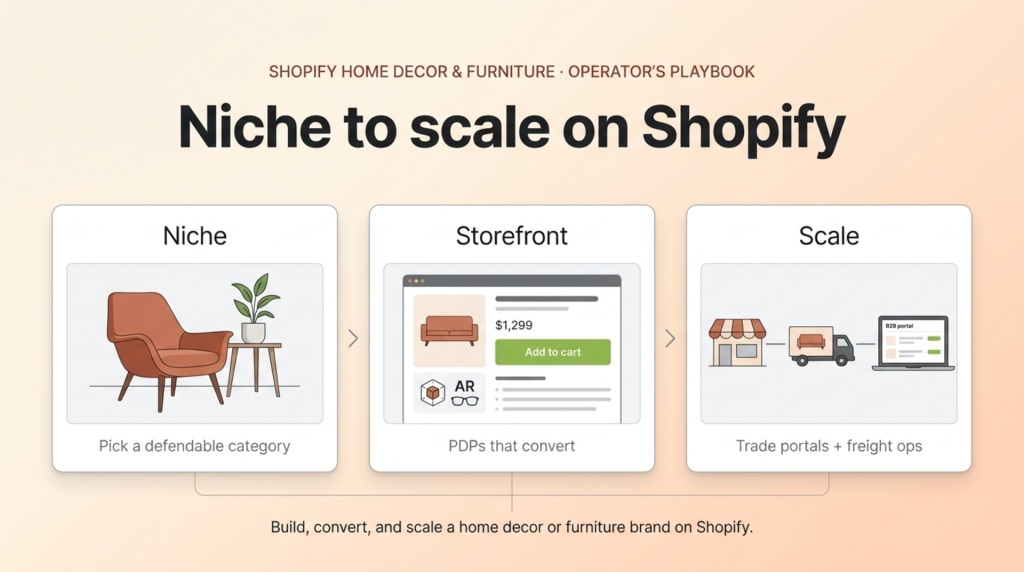
Home decor and furniture are among the most visually-led, highest-consideration categories in ecommerce. A buyer who is happy to one-click a $40 t-shirt will spend three weeks evaluating a $2,400 sofa, comparing dimensions, requesting fabric swatches, calculating delivery dates, and screenshotting product pages to send to a partner. The brands that consistently capture those buyers on Shopify aren’t necessarily the ones with the prettiest homepages. They’re the ones whose operators have made deliberate choices about catalog architecture, payment flows, freight logistics, and trade programs. Those choices compound into a meaningful conversion-rate advantage.
This playbook is for founders, marketers, and operators building or scaling a Shopify home decor or furniture brand in 2026. It assumes you already know that Shopify is a credible platform for this category. What it covers is the seven operator decisions that determine whether your store scales past its first $1M, plateaus, or quietly bleeds margin to competitors who picked a sharper theme, a smarter freight model, or a more disciplined niche.
Key Takeaways
- Why Shopify wins this category: native 3D/AR product media, freight-class shipping profiles, BNPL at checkout, and B2B portals on Shopify Plus, all out of the box.
- The 7 sections in this playbook: niche & positioning · theme & tech stack · PDP mechanics · conversion & checkout · furniture-specific ops · B2B trade & wholesale · marketing & retention.
- Time to launch: 4–8 weeks for a tight 50–200 SKU boutique on a premium theme; 12–20 weeks for a 1,000+ SKU multi-warehouse furniture brand.
- Budget reality: $5K–$25K for a boutique launch on a paid theme; $50K–$150K+ for an enterprise furniture build with custom freight logic and B2B trade.
- Spokes in this cluster: the 13 best home decor Shopify stores for visual benchmarks, the build guide for conversion mechanics, the Shopify for furniture stores guide for white-glove operations, and the best Shopify theme for home decor roundup for theme selection.
- Operator’s bias: the difference between brands that scale and brands that plateau is rarely the homepage. It’s the PDP, the BNPL placement, and the trade portal.
Why Shopify Works for Home Decor and Furniture (and Why Most Alternatives Don’t)
The home decor and furniture category exposes ecommerce platforms more brutally than almost any other vertical. Four problems must be solved natively, or your operations team will spend years fighting the tooling instead of building the brand:
High-fidelity product media. A buyer choosing between a walnut and oak coffee table needs to see grain, color shift under different lighting, and exact dimensions in context. Shopify supports native 3D model uploads and Augmented Reality (AR) on iOS and Android with no third-party app required. Brands that ship AR on their top 20 SKUs see meaningfully lower return rates on furniture, a margin protection most competitors miss.
Complex variant matrices. A modular sofa might come in 4 sizes × 12 fabrics × 3 leg finishes; that’s 144 variants. Shopify caps variants at 100 per product (with 2,000 in beta on Plus), but the broader point is that the platform’s catalog data model is built around variants, not bolted on. Magento and BigCommerce both support more variants in absolute terms; Shopify’s wins on operational simplicity.
Freight-class shipping. Shipping a 300-pound dining table is not a UPS problem. Shopify’s shipping profiles let you assign products to freight carriers, set lead times, expose accurate at-checkout costs, and route white-glove deliveries through third-party apps like ShipperHQ or Bolt. The native shipping engine handles the merchant-of-record side cleanly, with no carrier integration mess.
BNPL at checkout. Furniture buyers convert at materially higher rates when offered Buy Now, Pay Later. Shop Pay Installments, Klarna, and Affirm integrate as native checkout extensions. We see consistent 15–30% AOV lifts on items over $400 when BNPL is positioned correctly in the cart drawer.
The platforms most often weighed against Shopify in this category (Magento, BigCommerce, WooCommerce) each handle one or two of these problems well, but rarely all four without a stack of plugins, custom dev, or both. Shopify is the boring, unsexy answer: it solves all four, the merchant doesn’t have to think about infrastructure, and the team gets to focus on brand and merchandising. That’s the trade.
Niche & Positioning
Pick a vertical, then defend it
The single most common mistake we see in early-stage home decor brands is going too broad. “We sell beautiful objects for the modern home” is not a niche; it’s a feeling. Wayfair sells beautiful objects for the modern home. So does Target. So does AliExpress. You will not out-merchandise either of those budgets, and you will not out-personality the boutique that picked a tighter angle.
The brands that scale on Shopify in this category almost always start narrow:
- Ruggable owned machine-washable rugs before they expanded.
- Burrow owned modular, tool-free assembly sofas before they expanded.
- Parachute owned premium DTC bedding before they added bath, then home accessories.
- The Citizenry owned ethically-sourced artisan goods with named makers, full stop.
None of those positioning statements are interchangeable. Each one made a clear sacrifice (a category, a price point, a customer archetype) and built the rest of the brand around defending that sacrifice. The narrower your initial angle, the more memorable your brand becomes, and the lower your customer acquisition cost when you do launch paid traffic.
The niche-statement formula
For a working niche statement, try the formula: “We are the [adjective] [product category] for [specific buyer] who care about [non-obvious value].” If you can’t fill that in cleanly in one sentence, you don’t have a niche yet. You have a product list.
Theme & Tech Stack
Picking a theme by catalog scale
Once your niche is clear, the theme follows. Theme selection in this category is mostly about catalog scale and brand register, and there’s a small handful of premium themes that get used over and over for good reasons. Our best Shopify theme for home decor roundup breaks down all nine, but the operator’s shortlist is shorter than that:
| Catalog size | Brand register | Theme | Why |
|---|---|---|---|
| Under 200 SKUs, image-led | Boutique / minimalist | Horizon (free) | Online Store 2.0 baseline, perfect Core Web Vitals, ships fast |
| 200–1,000 SKUs | Mid-market DTC | Impulse ($400) or Broadcast ($420) | Built-in conversion tooling, sub-collections, sidebar filters |
| 1,000+ SKUs, multi-category | Retailer / scale | Warehouse ($320) or Expanse ($400) | Predictive search, structured collections, mega menu |
| Premium / high-ticket furniture | Luxury / heritage | Prestige ($400) | Editorial magazine layouts, timeline storytelling |
The mistake to avoid: buying a theme because the demo store is beautiful, then realizing it doesn’t support image hotspots, color swatches, or sticky add-to-cart on PDPs (features your category absolutely needs). Always install the theme as a draft, load 20–30 of your real products, and click through the mobile experience before committing.
The day-one app stack
Beyond the theme, your day-one tech stack should include: a reviews app with photo support (Loox, Judge.me, or Yotpo); a 3D/AR app or native Shopify model uploads for hero SKUs; an upsell/bundle app (Rebuy or similar); and a swatch app if your theme doesn’t ship with native color swatches. Resist the temptation to add 15 apps. Every app is a page-speed tax.
Read more → For a side-by-side breakdown of all 9 themes (Broadcast, Impulse, Horizon, Warehouse, Expanse, Prestige, Impact, Motion, Showcase), prices, and the right pick by catalog scale, read the best Shopify theme for home decor guide.
Product Page Mechanics That Actually Convert
If we had to pick one place where home decor brands win or lose, it’s the product detail page. The homepage gets too much credit and the PDP gets too little. The brands converting at 2.5%+ in this category share a small set of PDP patterns that the brands stuck at 0.8% routinely skip:
Above-the-fold spec block
Above-the-fold spec block. Dimensions, weight, material, lead time, and freight class all visible without a click. No accordions, no tabs hiding the answer to “will this fit through my doorway.”
Lifestyle photography + AR
Lifestyle photography in the gallery. Studio shots establish the product. Lifestyle shots establish the buyer. Buyers need spatial context: a sofa in an empty white box doesn’t sell; a sofa in a real living room with a coffee table and floor lamp does.
AR and 3D where it matters. AR doesn’t need to ship on every SKU on day one. Ship it on the top 20: the high-margin, high-AOV pieces customers spend the most time deliberating. The data is consistent: AR-equipped products see lower return rates and longer dwell time.
Color and material swatches that are visual. A dropdown that says “Walnut” tells the buyer nothing. A swatch that shows walnut shifts the conversation. This sounds basic; you’d be surprised how many premium brands still use text dropdowns.
Sticky cart and honest shipping
Sticky add-to-cart. On a 2,500-word PDP for a $3,000 sectional, the add-to-cart button must remain accessible as the buyer scrolls. A theme that ships with sticky-cart support saves you from implementing it custom.
Honest shipping and return policies. Hide them and your cart abandonment will spike. Surface free-shipping thresholds in the announcement bar; expose freight cost ranges before the cart; link to the return policy from the PDP, not just the footer.
Read more → For a section-by-section walkthrough of high-converting PDPs, the right app stack, and the 4-step launch flow with worked examples, read the build guide for high-converting home decor Shopify stores.
Conversion & Checkout
By the time a buyer reaches the cart, the heavy lifting is done. The job at checkout is to not lose them. Three patterns separate the brands that close from the brands that bleed:
BNPL placement, not just availability
BNPL placement matters more than BNPL availability. Every premium furniture brand offers Shop Pay Installments or Klarna. Most do it badly, burying the BNPL badge inside the checkout flow, where the buyer has already decided to abandon. Surface the BNPL message in the cart drawer (“Pay $250/mo with Shop Pay Installments”), not just at the payment step. The 15–30% AOV lift this category sees from BNPL evaporates if the buyer doesn’t see the option until after they’ve calculated full price.
Cart drawer beats cart page
Cart drawer beats cart page. Side-drawer carts keep the buyer on the collection or PDP they were browsing. Full-page cart redirects break flow. Most premium themes default to drawers; if yours doesn’t, swap it.
Shopify Checkout extensibility
Shopify Checkout extensions over Liquid hacks. The Checkout Extensibility framework launched in 2023 and matured through 2025. It lets you add upsells, gift-with-purchase logic, and trust badges to checkout without hacking checkout.liquid (which Shopify is sunsetting). Use the extensibility framework. Don’t lock yourself into deprecated patterns.
If your conversion rate is sitting under 1.5% on warm traffic, the fix is almost always at the cart and checkout layer, not at the top of the funnel. Conversion rate optimization in this category is mostly about removing friction, not adding bells and whistles. Our Shopify CRO services page walks through the diagnostic process; the build guide covers the tactical fixes.
Furniture-Specific Operations
Decor and furniture share a customer but split operationally somewhere around the 50-pound mark. A ceramic vase ships UPS Ground; a sectional sofa needs freight, lift-gate service, and frequently a white-glove appointment. If furniture is more than 30% of your catalog, plan for these four operational realities from day one, not in year two when an angry customer leaves a one-star review about a couch left on their lawn.
Freight shipping profiles
Freight shipping profiles. Shopify’s shipping profiles segment your catalog by carrier. Build separate profiles for parcel-shippable items (UPS, FedEx) and freight items (LTL carriers, white-glove services). Expose accurate at-checkout costs. Flat-rate freight with a cap at $399 is an honest framing buyers respond to better than “freight quoted at checkout.”
White-glove and BOPIS
White-glove and delivery scheduling. Apps like Bringoz, Onfleet, or AfterShip Couriers integrate with Shopify to capture installation windows, generate driver manifests, and let buyers self-schedule deliveries. The post-purchase email sequence should include shipping milestones (“Your sofa is in our regional warehouse” → “Driver assigned” → “Delivery scheduled for Thursday 9–11am”), because a $3,000 purchase deserves more communication than a $30 t-shirt.
BOPIS and showroom integration. If you have a physical showroom, the Shopify POS lets you sell in-store with the same SKU and customer database. Buy Online, Pick Up In-Store (BOPIS) flows reduce shipping costs and create a foot-traffic loop. Buyers who walk in to pick up a $200 lamp often leave with a $1,500 chair too.
Returns logistics
Returns logistics for big items. Returns on furniture are not the same as returns on a t-shirt. The honest answer is most furniture sales are non-returnable or restocking-fee returns, and that’s fine as long as you communicate it before the buyer clicks add-to-cart. Surface the policy on the PDP, not in the footer fine print.
Read more → For vertical-specific app recommendations (Bringoz, Onfleet, ShipperHQ), carrier integrations, the Shopify POS setup checklist, and showroom-to-online inventory unification, see the Shopify for furniture stores complete guide.
B2B Trade & Wholesale
When you’re ready for a trade portal
Most home decor and furniture brands launch DTC and discover, somewhere between $500K and $2M in annual revenue, that interior designers are quietly responsible for 20–40% of their order volume, at higher AOVs and meaningful repeat-purchase rates. The brands that recognize this early and build a real B2B trade portal capture a recurring revenue stream that DTC marketing economics cannot match.
According to McKinsey’s B2B research, 73% of B2B buyers prefer digital channels for supplier discovery and evaluation. For a home decor brand, that translates directly into interior designers who’d rather log into a trade portal at 10pm than email a wholesale rep and wait 48 hours for a quote.
The signals that you’re ready for a trade portal: at least 15% of your DTC orders include a “send me a quote for 6 of these” message; you’re getting >5 inbound emails a month from interior designers asking about wholesale; or your DTC AOV is plateauing while your top customers are quietly placing $4K–$8K orders that you’re processing manually. If any of those are true, a trade portal pays for itself within two quarters.
Building it on Shopify Plus
Shopify Plus ships with B2B on Shopify as a native capability: separate B2B catalogs with tiered pricing, net-30 payment terms, tax-exempt customer flags, and dedicated B2B-only collections. Since the July 2026 collections rebuild, those trade groupings can be built as native sub collections that source your existing retail collections instead of duplicating them. The setup is meaningful but not custom-build territory; an experienced Shopify Plus partner can stand up a working trade portal in 4–6 weeks.
Trade buyers are not retail buyers in disguise. They want clean line-item invoices, the ability to copy past orders, and predictable lead times, not lifestyle photography or limited-time-offer countdowns. Build the trade portal as a separate experience inside your Shopify Plus organization, not as a discount code bolted onto your DTC site.
Marketing & Retention
Three durable channels
Home decor is an aspirational category with a long consideration window. The brands that scale invest in three durable channels and largely ignore the rest:
Visual social: Instagram, Pinterest, TikTok. Lifestyle photography of your products styled in real homes is the single most-leveraged marketing asset you can produce. Pay for one professional editorial shoot per quarter; squeeze 60–90 social posts out of each shoot. Pinterest in particular drives long-tail search traffic for home decor for years, not weeks. Every pin is an evergreen asset.
Email and SMS lifecycle. Welcome series, browse abandonment, cart abandonment, post-purchase, and a quarterly aesthetic-newsletter cadence are non-negotiable. Klaviyo or Omnisend both work well; the deciding factor is integration depth with your reviews and BNPL providers. Decor purchases have long consideration windows: a buyer who browsed a sofa today might convert in 21 days, not 21 minutes.
Influencer and designer partnerships. Interior designers are simultaneously your B2B customers and your most credible influencers. Send free product to 50 mid-tier interior designers a year; the styled-in-the-wild content they produce outperforms most paid ad creative.
What to skip
What we’d skip: aggressive paid social on cold traffic for high-AOV furniture (the consideration cycle is too long for the attribution model to work cleanly), and SEO content that targets head terms you can’t realistically win against Wayfair and Houzz. Better to own a niche and rank for “best modular sofa for small apartments” than fight for “best sofa.”
Best-in-Class Examples by Operator Decision
Each of the seven decisions above maps to brands you can study directly. The table below cross-references which brand demonstrates which decision well.
| Operator decision | Brand | What they do well |
|---|---|---|
| Niche & positioning | Ruggable | Owned “machine-washable rugs” as a single, defensible position |
| Theme & tech stack | Lulu and Georgia | Editorial Prestige-style layout with deep faceted filtering |
| PDP mechanics | Burrow | Above-the-fold tool-free assembly demos via video and GIF |
| Conversion & checkout | Brooklinen | Bundle-driven AOV lift with clear BNPL placement |
| Furniture-specific ops | Arhaus | Showroom + online inventory unified through Shopify POS |
| B2B trade | The Citizenry | Trade program with tiered pricing for interior designers |
| Marketing & retention | McGee & Co. | Studio McGee content arm drives evergreen Pinterest traffic |
Read more → For the full breakdown of all 13 stores with screenshots, UX patterns, and the lessons each brand demonstrates, read the 13 best home decor Shopify stores roundup.
The brands we’ve migrated, built, or optimized in this category share a pattern that surprises most founders: the homepage is rarely the constraint. Across our home decor and furniture engagements, the consistent before-and-after lifts come from PDP restructures (sticky cart + above-fold spec block), BNPL repositioning into the cart drawer, and the operational unlock of a real B2B trade portal in year two. None of those are glamorous. All of them compound. The brands that scale past their first $1M almost always look the same operationally: niche-narrow, theme-disciplined, PDP-obsessed, freight-honest, and B2B-aware. The brands that plateau are usually the ones still tweaking the homepage hero a year in.
Frequently Asked Questions
Is Shopify good for home decor and furniture brands?
Yes, Shopify is the strongest mainstream platform for home decor and furniture because it natively handles the four hard problems in this category: high-fidelity 3D and AR product media, complex variant matrices, freight-class shipping profiles, and BNPL financing at checkout. Magento and BigCommerce can match individual capabilities, but Shopify wins on operational simplicity and merchant-of-record handling.
What does it cost to launch a home decor Shopify store?
A boutique launch with under 200 SKUs on a premium theme typically lands between $5,000 and $25,000, including theme purchase, design customization, photography, and initial app stack. Enterprise furniture builds with custom freight logic, multi-warehouse inventory, and B2B trade portals usually run $50,000 to $150,000+. Solo founders launching on Horizon (free) with their own product photography can ship for under $1,000.
Do I need Shopify Plus for home decor or furniture?
Most boutiques don’t. Shopify’s Basic, Shopify, and Advanced plans handle DTC home decor up to roughly $2M in annual revenue cleanly. The Plus upgrade ($2,500+/month) is justified when you need native B2B (interior designer trade portals), multi-storefront for international markets, advanced checkout customization, or Shopify Functions for custom discount logic. If you’re under $2M and DTC-only, Plus is usually premature.
What’s the best Shopify theme for a mixed home decor and furniture catalog?
For mixed catalogs spanning small accessories and large furniture, Impulse ($400) and Broadcast ($420) are the most reliable picks. Both ship with deep faceted filtering, native swatches, sticky add-to-cart, and image hotspots. For 1,000+ SKU catalogs, Warehouse ($320) is purpose-built for predictive search at scale. The full theme breakdown is in our best Shopify theme for home decor roundup.
How do I handle freight shipping on Shopify?
Use Shopify’s shipping profiles to segment products by carrier — assign parcel-shippable items to UPS or FedEx and freight items to LTL carriers or white-glove services. For real-time freight quotes at checkout, integrate ShipperHQ or Bolt. For delivery scheduling, white-glove logistics, and driver routing, integrate Bringoz, Onfleet, or AfterShip Couriers. Expose accurate freight costs at checkout — buyers respond better to honest flat-rate freight than to “quoted at checkout.”
Can I sell to interior designers (B2B) on Shopify?
Yes, Shopify Plus includes B2B as a native capability with tiered pricing, net-30 payment terms, tax-exempt customer flags, and B2B-only catalogs. The setup typically takes a Shopify Plus partner 4–6 weeks. Signals you’re ready: at least 15% of your DTC orders include “send me a quote for 6” messages, or you’re getting more than 5 inbound trade inquiries a month. Interior designer revenue typically converts at 3–5× retail rates with meaningful repeat-purchase volume.
How long does it take to launch a home decor Shopify store?
A focused boutique launch on a premium theme with 50–200 SKUs typically takes 4–8 weeks end-to-end (theme setup, product upload, photography, app integration, payment and shipping configuration, soft launch). Enterprise furniture builds with custom freight logic, multi-warehouse inventory, and a B2B trade portal usually run 12–20 weeks. The deciding factor is rarely Shopify itself — it’s photography readiness and the time it takes to clean up product data from a legacy system if you’re migrating.
Conclusion
Selling home decor and furniture on Shopify is a well-understood problem in 2026. The platform handles the category, the themes are mature, the apps are stable, and the operator playbook is documented (this article being one attempt at it). What separates the brands that scale from the brands that plateau is rarely platform choice or theme selection. It’s the discipline to pick a niche and stay narrow, the willingness to invest in PDPs more than homepage hero variants, and the operational maturity to recognize when interior designers are quietly building your second revenue stream.
If you’re at the start of this (pre-launch, pre-revenue, or at the first real plateau), the spokes attached to this playbook go deeper on each play. The 13 best home decor Shopify stores shows you the visual benchmark; the build guide walks through PDPs and conversion mechanics; the Shopify for furniture stores guide covers freight, white-glove, and showroom integration; and the best Shopify theme for home decor roundup picks the right foundation for your catalog scale.
If you’re past the planning stage and want a direct review of your current build (or you’re considering a migration onto Shopify from a legacy platform), reach out and we’ll walk through your specific situation.