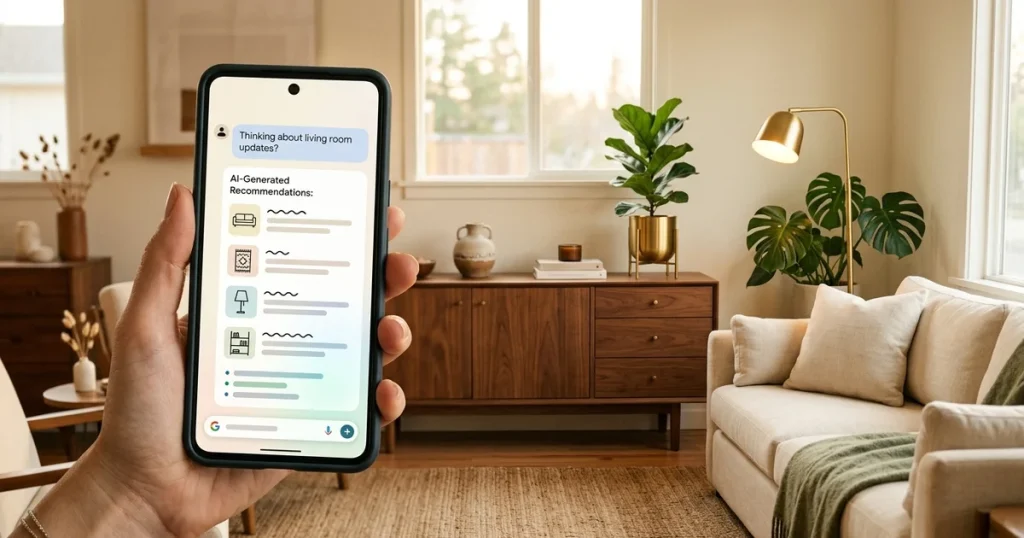
Picture a shopper ten minutes from your showroom asking ChatGPT where to buy a walnut mid-century sideboard. We ran that exact question for Atlanta on October 5, 2026 (one run, web search on). The written answer was good news for independents: it named six local vintage and modern dealers and suggested starting with them rather than big-box stores. The product cards under it, the part with photos, prices and buy links, told a different story. Three of the four came from Home Depot, Overstock and Wayfair.
One test is a snapshot, and the bigger picture is worse. A September 2026 study of nearly 500,000 AI shopping answers was run by Vaer AI for Lightspeed, which sells POS systems to independent retailers. It found that a big chain won the top recommendation about 2.5 times as often as a small store (Vaer AI).
The causes are mostly data problems, and most of the fixes live inside your Shopify store. Those product cards are where conversational sales in ChatGPT start, so getting your catalog into them matters as much as getting your name into the written answer. This guide covers what the research shows, why AI favors big retailers, and seven steps independent furniture and home decor stores can take this month.
Key Takeaways
- AI shopping answers favor big chains: with web search on, chains took 46% to 58% of recommendations, while small stores made up only about a quarter of the stores named.
- When shoppers add “independent” to their prompt, small stores make up nearly four out of five picks. “Local” and “near me” barely help.
- In Yext’s analysis, 86% of AI citations came from sources a business controls: its website and its listings.
- The fastest fixes are a complete Google Merchant Center feed, product specs stored as Shopify metafields, and complete Google Business Profile and Yelp listings.
How often does AI recommend big chains over independent stores?
Big chains win most AI shopping recommendations. Vaer AI, commissioned by Lightspeed, ran 20,000 shopping prompts through ChatGPT and Google’s AI tools (AI Mode, AI Overviews and Gemini) in four cities between June and August 2026. Across runs with web search on and off, that produced just under half a million answers (Lightspeed). With live web search on, big chains took 46% to 58% of recommendations, and small or local stores made up about a quarter of the stores named (Vaer AI).
The gap gets wider in three situations:
- When the AI relies on memory. With web search off, chains took 63% to 70% of recommendations and small stores got about one pick in ten.
- In head-to-head choices. Asked to pick between a big store and a small one using its training data alone, AI chose the big store 90% to 94% of the time.
- In Google AI Overviews. About two out of three Overview answers (68%) named no small or local store at all.
The prompt wording matters more than location. Adding “independent” to a prompt raised small stores from about a third of picks to nearly four-fifths. Adding “local” or “near me” barely changed ChatGPT’s answers, because it counts a nearby chain store as local (Vaer AI).
Specific questions hurt independents most. Broad browsing questions put a small store in the top spot about one time in three, but questions about a specific product dropped that to as little as one in ten (Lightspeed). For a furniture store, that’s the shopper who already knows the style, size and wood they want, and is often ready to buy.
The study covered 10 product categories, and its published findings don’t break out furniture. Our sideboard test hints at how the pattern may show up in furniture: specialist local shops can still win the written answer, while the shoppable product cards go to retailers with connected product feeds. That’s one test, not a measured result, but it shows where the fixes below matter most.
Why AI search matters for furniture and decor stores now
AI is becoming a regular part of how people find stores. In BrightLocal’s 2026 survey of 1,002 US adults, use of ChatGPT and other AI tools for local business recommendations rose from 6% to 45% in a year. That makes AI the third most popular source, behind Google and Facebook (BrightLocal, Feb 2026).
Holiday traffic will make the gap more expensive. Adobe forecasts that traffic from AI tools to US retail sites will rise 130% year over year this holiday season, from November 1 to December 31 (Adobe, Sept 2026).
Furniture shoppers still research online and buy in person. In a February 2026 survey of 400 US furniture buyers who spent $500 or more in the past six months, 42% shopped both online and in store, 33% shopped in store only and 25% shopped online only. The study notes that most shoppers still browse websites before buying in store (3D Cloud, which sells 3D product visualization to furniture retailers, with Provoke Insights). If AI never names your store during that research step, the showroom visit may never happen. That handoff from online research to the showroom floor is the core of any omnichannel retail strategy, and AI answers are now part of the online half.
Big retailers are also starting to pay for a place in the conversation. In September 2026, OpenAI began testing Sponsored Agents: branded chatbots that shoppers open from an ad inside ChatGPT, which then hand them off to the business’s website (Search Engine Roundtable). Wayfair is among the pilot advertisers (Yahoo Finance, Sept 2026). Independent stores can’t match that budget, so the free signals below matter more.
Why do ChatGPT and Google AI pick the big retailers?
AI assistants recommend what they can find, read and verify. Big retailers win on all three, partly because of better data and partly because models already know their names.
They’re in the shopping feeds AI draws from
Peec AI, which sells AI-visibility tracking, analyzed about 5,000 ChatGPT product carousels containing about 43,000 products. 83% matched Google’s top 40 organic shopping results, while only 11% matched Bing (Search Engine Land, Mar 2026). A store with no Google Merchant Center feed, or a thin one, is mostly missing from that pool.
Their product data answers long questions
Shoppers now ask detailed questions, such as “performance-fabric sofa under 84 inches, kid-friendly, delivered before Thanksgiving.” An AI can only compare facts that are written down. Channable, which sells feed-management software, audited 9,689 merchants on its own platform in October 2026. 77% scored below 60 out of 100 on AI readiness, and fewer than 1% scored 80 or higher. Key product information used by AI shopping surfaces was missing, incomplete or inconsistent (ChannelX).
The model already knows their names
With live search off, chains took 63% to 70% of recommendations in the Vaer study. That likely reflects training data: years of press, reviews and links. You can’t change that this month, but you can act on the next point.
Most citations come from sources you control
This is the good news for independents. Yext, which sells listings software, analyzed 6.8 million citations in ChatGPT, Gemini and Perplexity answers. It found that 86% came from sources brands control: 44% from websites and 42% from business listings. Reviews and social made up 8%, and forums 2%. In retail, first-party websites alone were 47.6% of citations (Yext, Oct 2025).
How to get your store recommended by ChatGPT: 7 steps
Steps 1 to 3 are the foundation. Each one feeds several AI surfaces at once.
Before you begin: you’ll need admin access to Shopify and Google Business Profile, a Google Merchant Center account and a claimed Yelp business page. Steps 1 and 2 may need a developer if your catalog has many variants.
Step 1: Put your full catalog in Google Merchant Center
Connect Shopify’s Google & YouTube channel and sync every product, not only the bestsellers. Fill in brand, GTIN or MPN (the barcode or manufacturer part number), color, material and condition. Fix every disapproved product in Merchant Center. Because most ChatGPT carousel products match Google’s organic shopping results, this step reaches the most AI surfaces.
Step 2: Turn product specs into structured data with metafields
Store each spec a shopper might ask about as its own Shopify metafield: overall dimensions, seat height, fabric content, finish, weight capacity, assembly and lead time. Show those fields on the product page, and make sure color, material and size also reach your Merchant Center feed. If core data such as the title, description or category lives in metafields, Shopify’s Catalog Mapping tells Shopify where to find it for AI channels. A spec buried in a paragraph or a PDF line sheet is much harder for an AI to compare. The same structured fields power site search on a furniture store and a well-built Shopify product page, so the work pays off more than once.
Step 3: Review your agentic storefront settings
Shopify’s agentic storefronts control whether your products show up in AI shopping surfaces such as ChatGPT, Google AI Mode and Gemini, Microsoft Copilot and Meta. You’ll find them under Sales channels > Agentic in your Shopify admin. In our sideboard test, one of the four product cards went to Crafters & Weavers, a smaller Shopify furniture brand, right next to Wayfair. That card came through Shopify’s catalog. These settings also decide how much control and customer ownership your brand keeps when an AI agent makes the sale.
Check which platforms are turned on rather than accepting the defaults, and note three details that matter for furniture:
- ChatGPT sends shoppers to your own checkout, opened inside ChatGPT, so your checkout has to work well on a phone.
- Customizable products can’t use direct checkout on Google AI Mode, Gemini, Copilot or Meta. That includes fabric or finish choices built with line-item properties (Shopify).
- Google AI Mode and Gemini require a US-based store. For eligible stores, Google’s direct checkout is on by default. ChatGPT and Copilot only require that you sell to US buyers.
Step 4: Say “independent” clearly and consistently
Shoppers who type “independent” get small stores in nearly four out of five picks, so make the word easy to match. Use a plain line such as “independent, family-owned furniture store in [City] since [year]” on your homepage, About page, Google Business Profile description and FurnitureStore or Organization schema (the site code that tells search engines your business details). Use the same wording everywhere so the AI sees one clear fact. The Vaer study measured shopper prompts, not site copy, so treat this as a reasonable inference rather than a proven lever.
Step 5: Complete your Google Business Profile and Yelp listing
Listings made up 42% of AI citations in the Yext data, so your profiles matter. On your Google Business Profile, add accurate hours, categories, products, photos and your showroom address. Then claim and complete your Yelp page with the same details. ChatGPT now has its own business profiles too, and Shopify merchants can verify by connecting their store, which our guide to claiming your business in ChatGPT covers. In our two ChatGPT tests, 8 of the 13 local store cards linked to Yelp or Tripadvisor listings.
If your profile shows a “Collected info” tab, review it too. It lists details Google’s automated assistant gathered by calling or messaging your business, and you can delete wrong entries. Deleting an entry doesn’t change what’s already on your profile, and the tab is only available in some regions and business categories (Google).
Step 6: Show what’s on your showroom floor
If you sell with Shopify POS, turn on Google local inventory so products can show as in stock at your store. That signal is only as good as your POS counts: a floor model sold on Saturday has to come off the feed on Saturday, which is why Shopify POS inventory management matters as much as the Google setup. “Available to see today, ten minutes away” is something an online-only retailer can’t offer.
Step 7: Earn detailed reviews and local list mentions
In BrightLocal’s 2026 survey, 82% of consumers said they read AI-generated review summaries to inform decisions (BrightLocal). Ask happy customers to mention the piece they bought and how it fits their room. A review such as “the sofa held up to two dogs” gives an AI far more to work with than “great store.”
Local lists matter too. When we asked ChatGPT for the best furniture stores in Atlanta, its answer cited city guides from Atly and Atlanta.com. Pitch local design blogs and city “best furniture stores” lists so your store is on the pages AI reads.
None of these steps is a trick. They’re the same signals on our Shopify SEO checklist, aimed at the longer questions shoppers now ask AI.
How do you test your store’s AI visibility?
Run five prompts for your main category in ChatGPT, Google AI Mode and Gemini, and write down which stores get named. Use ChatGPT’s Temporary Chat or a logged-out session, plus a private browser window, so your own history and saved memory don’t skew results.
| # | Prompt type | Example prompt |
|---|---|---|
| 1 | Broad, with city | Best furniture stores in Atlanta |
| 2 | Independent | Independent home decor stores in Atlanta |
| 3 | Specific product | Where can I buy a walnut mid-century sideboard in Atlanta? |
| 4 | Problem-based | Durable sofa for a family with dogs, under $3,000, near Decatur |
| 5 | Comparison | [Your store] vs. West Elm for dining tables |
Check both parts of each answer: the written recommendations and the product cards. In our sideboard test, they named completely different stores.
Repeat the test monthly and track how often your store appears. If you never show up in the product cards for prompt 3, your product data and feed need work. If you never show up for prompt 2, start with your “independent” wording and your Google and Yelp listings.
AI shopping visibility FAQs for furniture stores
Can I pay to get my store recommended by ChatGPT?
You can buy visibility, but not organic recommendations. In September 2026, OpenAI began testing Sponsored Agents, which open from ads inside ChatGPT and hand shoppers off to the advertiser’s website. Wayfair is among the pilot advertisers (Yahoo Finance). Organic recommendations still depend on your product data, feeds and listings.
Does “near me” SEO help with AI recommendations?
Only a little. In the Vaer study, adding “local” or “near me” barely changed ChatGPT’s answers, because a nearby chain store counts as local. Clear “independent” positioning and complete Google and Yelp listings do more.
Do I need Shopify Plus to appear in AI shopping results?
No. The Google & YouTube channel and metafields are available on standard Shopify plans, and agentic storefronts need the Starter plan or higher (Shopify). Google local inventory needs Shopify POS, a physical store and at least 10 products. Google AI Mode and Gemini also require a US-based store.
How long does it take to show up in AI answers?
There’s no published timeline. Feed and listing changes are picked up as Google and AI tools recrawl, so re-run the five-prompt test monthly and compare results.
The bottom line for independent stores
You don’t need Wayfair’s ad budget to show up in AI answers. You need data an AI can read and a clear signal that you’re the independent store with the piece in stock.
- Put your full catalog in Google Merchant Center first.
- Store product specs as metafields, not paragraphs.
- Use the word “independent” consistently and complete your Google Business Profile and Yelp listing.
- Re-run the five-prompt test monthly, checking both the written answer and the product cards.
Soda Web Media helps independent furniture and home decor retailers connect their showroom and Shopify store, so shoppers and AI assistants can find what’s on the floor. Book a free discovery call to talk through your catalog, feeds and listings.